
Phoenix | PM-10 Nonattainment Area
Counties Affected:
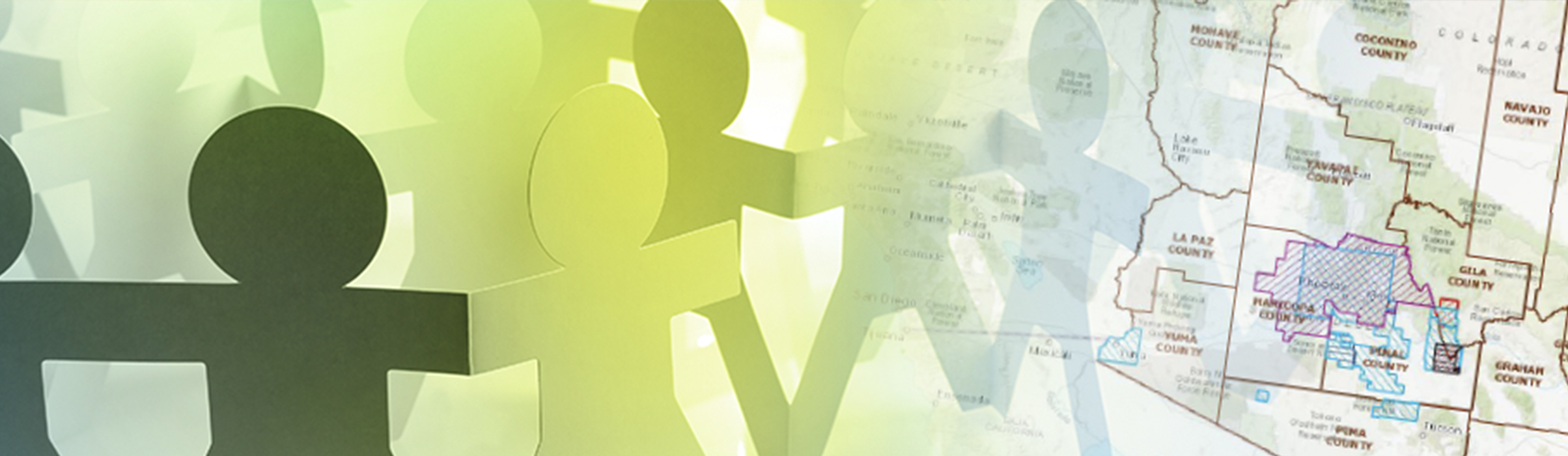
Parts of Maricopa and Pinal Counties | View eMap >
Nonattainment Area Designation and Reclassification Dates:
Designation as nonattainment for the PM10 National Ambient Air Quality Standards (NAAQS) with a moderate classification on Nov. 15, 1990. Learn more about the designation of the area in the Federal Register (56 FR 56694) | View >
Reclassification to a serious nonattainment area for the PM10 NAAQS on June 10, 1996. Learn more about the designation of the area in the Federal Register (61 FR 21372) | View >
Classification Level:
Serious classification for the PM10 1987 NAAQS
Pollutant of Concern:
PM10 (particulate matter 10 microns or less in diameter)
Summary:
The concentration of PM10 in the Phoenix Nonattainment Area is above the NAAQS established by the U.S. Environmental Protection Agency (EPA). In 2012, Maricopa Association of Governments (MAG), in conjunction with the Arizona Department of Environmental Quality (ADEQ), Maricopa County Air Quality Department (MCAQD), and Pinal County Air Quality Control District (PCAQCD), submitted an updated State Implementation Plan (SIP) that demonstrates a reduction of PM10 by five percent each year to improve the area's air quality. The Five Percent Plan was approved by EPA on June 10, 2014 (79 FR 33107). The control measures included in the EPA-approved SIP continue to provide on-going reductions in PM10 emissions throughout the nonattainment area.
The following is a description of each agency’s roles and responsibilities as they pertain to the Phoenix PM10 Nonattainment Area:
- Maricopa Association of Governments (MAG) — Under A.R.S. § 49-406, MAG is responsible for air quality planning for the Phoenix PM10 Nonattainment Area. While MAG is responsible for air quality plans, it has no enforcement powers or authority to pass laws or rules | Learn More >
- ADEQ — ADEQ sets and enforces state-level rules, issues air quality permits for facilities within ADEQ’s permitting jurisdiction, and inspects ADEQ permitted facilities to ensure compliance with permit conditions.
- Maricopa County Air Quality Department (MCAQD) — MCAQD sets and enforces county-level rules, issues air quality permits for facilities within Maricopa County’s permitting jurisdiction, and ensures that Maricopa County permitted facilities remain in compliance with permit conditions | Learn More >
- Pinal County Air Quality Control District (PCAQCD) — PCAQD sets and enforces county-level rules, issues air quality permits for facilities within Pinal County’s permitting jurisdiction, and ensures that Pinal County permitted facilities remain in compliance with permit conditions | Learn More >
Regulatory Background:
To meet the requirements of Section 189(d) of the Clean Air Act, the MAG 2007 Five Percent Plan for PM10 was submitted to EPA by the federal deadline of Dec. 31, 2007. Collectively, the Five Percent Plan included fifty-three control measures that were implemented through a combination of Arizona Statutes, Maricopa County Rules, and a Maricopa County Ordinance. On Sept. 9, 2010, the EPA published a notice of proposed partial approval and disapproval of the plan in the Federal Register.
On Jan. 25, 2011, ADEQ voluntarily withdrew the MAG 2007 Five Percent Plan for PM10 to address technical approvability issues and include new information, such as the new EPA equation for paved road dust emissions. The 2012 Five Percent Plan was designed to be a replacement for the 2007 plan that was withdrawn, to meet the requirements in Section 189(d) of the Clean Air Act, and to improve air quality in the Phoenix PM10 Nonattainment Area.
MAG 2012 Five Percent Plan for PM10 for the Maricopa County (Phoenix) Nonattainment Area | View >
The EPA finalized its approval of the MAG 2012 Five Percent Plan for PM10 for the Maricopa County (Phoenix) Nonattainment Area on June 10, 2014 (79 FR 33107) | View >
Sources of PM10 within the Nonattainment Area:
- Dust from paved and unpaved roads
- Construction
- Windblown dust
- Unpaved parking lots
- Agricultural activities
- Offroad recreational vehicles
- Fuel combustion and fires
- Vehicle exhaust, tire wear, and brake wear
For more information, join our email list | Subscribe >
For questions, email our team | Email >
Unfamiliar with some of the acronyms or technical terms used on this page?
Visit our glossary | View >