
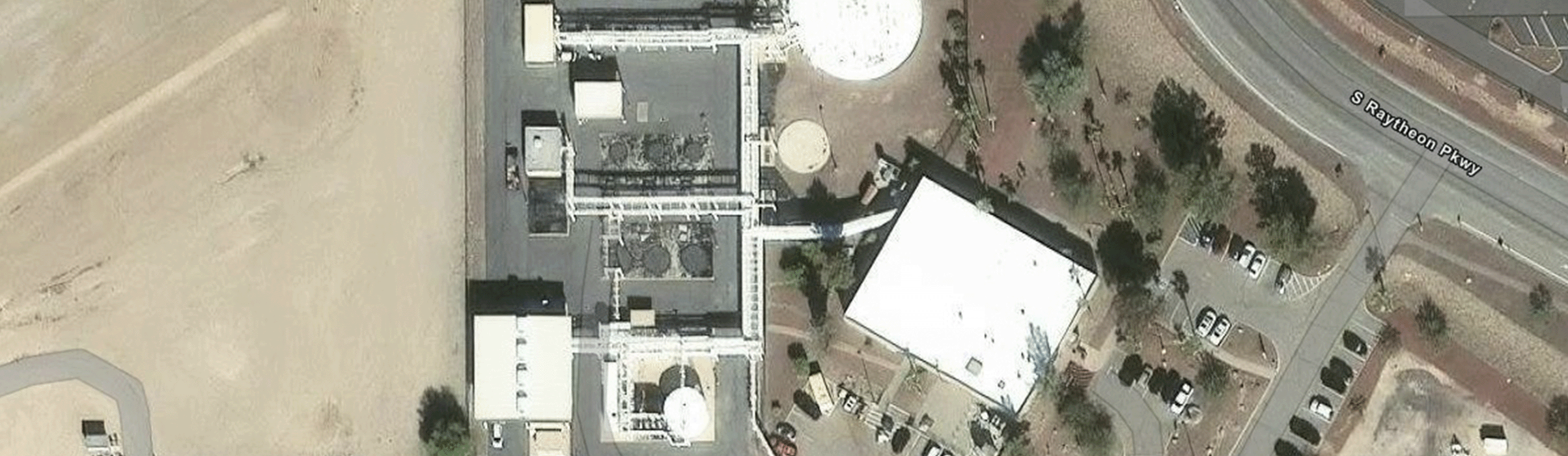
U.S. Air Force Plant 44 (AFP-44)
EPA#: AZD980737530
Superfund National Priority List (NPL) Placement: Sept. 8, 1983
Location
The Tucson International Airport Area (TIAA) Superfund Site covers an area of approximately 7,500 acres and is divided into seven separate project areas. The project areas include: Air Force Plant 44, Tucson Airport Remediation Project, Texas Instruments (formerly Burr-Brown), Morris Air National Guard, Airport Property, West Plume B, and West-Cap.
The AFP-44 plant is located about eight miles south of downtown Tucson, Arizona and is bounded to the north by Raytheon, the east by the Tucson International Airport, the south by Hughes Access Road and the west by the Nogales Highway (Route 89) | View Map >
Contaminants of Concern (COCs)
Soil | Site 1 (Ranch Site), Site 2 (Final Assembly and Checkout (FACO) Landfill), and Site 3 (Inactive Drainage Channel Disposal Pits)
Total petroleum hydrocarbons and trichloroethene (TCE). There is little to no health risk unless there is contact with skin or ingestion of contaminated soil.
Site 5 (WP005)
Metals and TCE in soil and soil vapor. Because much of the area is covered with concrete or asphalt there is little to no health risk of contact with skin or ingestion of contaminated soil. A 2018 supplemental soil vapor intrusion assessment showed that soil vapor samples collected in building 801’s basement area exceeded the TCE industrial indoor air Regional Screening Level. Additionally, because the soil underneath Building 801 cannot be fully characterized until the building is demolished, there are unknown risks to construction workers if the concrete floor and/or soils below Building 801 are disturbed.
Fire Engine Wash Area (FEWA), Fire Engine Wash Outfall (FEWO), and Building 864
Per- and Polyfluoroalkyl Substances (PFAS) have been detected at concentrations above their project screening levels. These include: perfluorooctanoic acid (PFOA), perfluorooctanesulfonic acid (PFOS), and perfluorononanoic acid (PFNA).
Groundwater | Chromium, volatile organic compounds (VOCs) especially TCE, 1,1-dichloroethene (1,1-DCE), 1,4-dioxane, and PFAS.
At the FEWA, FEWO, and Building 864, four PFAS have been detected in groundwater at concentrations above their federal drinking water standards. These include: PFOA, PFOS, perfluorohexanesulfonic acid (PFHxS) and PFNA. An additional federal drinking water standard has been established for a mixture of PFHxS, PFNA, HFPO-DA, and PFBS. If two or more of these compounds are detected in a sample then a hazardous index is calculated based on the detected concentrations. The federal drinking water standard for the mixture has been exceeded at AFP44.
If you have a private well in the vicinity of the exceedance, we encourage you to test the well water.
Not sure what to test for? | Learn More >
Other | PFOS has been detected in surface water exceeding the project screening limit of 4 parts per trillion.
COCs at the site may change as new data become available.
Action Taken
Site 1 (Ranch Site), Site 2 (FACO Landfill), and Site 3 (Inactive Drainage Channel Disposal Pits)
Completed remedial actions include soil vapor extraction (SVE), in-situ remediation, and/or soil excavation. A total of 95,562 pounds of VOCs were removed.
Site 5 (WP005)
Remedial activities have included soil removal and dual-phase extraction. Approximately 14,124 lbs of VOCs were removed by the dual-phase extraction system. Interim measures at Building 801 include deployment of air purifying units, sealing of potential vapor intrusion pathways, and adjustments to the heating, venting and air conditioning (HVAC) system.
Fire Engine Wash Area (FEWA), Fire Engine Wash Outfall (FEWO), and Building 864
Soil, sediment, and/or groundwater sampling was conducted in 2023 to 2024. The results have been reported in a draft Remedial Investigation report issued in July 2025.
Groundwater (OT012)
To contain contaminated groundwater the Air Force operates a large-scale pump-treat-reinject system. Contaminated groundwater is removed by a network of extraction wells, pumped to a groundwater treatment plant, treated to remove contaminants, and pumped back into the ground using a network of recharge wells located at the perimeter of the site to help provide hydraulic containment of the plume.
Starting in the late 1980s contaminants were removed from the extracted groundwater using air stripping technology. Starting in 2009, this technology was replaced with an advanced oxidation process (AOP) system for chemical oxidation of TCE, 1,1-DCE, and 1,4-DX. Starting in April 2019 the groundwater treatment system went off-line due to faulty underground cables. The system was repaired and came back on-line in August 2023.
In addition to the containment activities noted above, long-term maintenance and administrative controls are in-place to measure the progress of remedial actions and limit use of groundwater.
Other
The assessment of PFAS at AFP44 started in 2018 with a Preliminary Assessment report followed by a Site Inspection report. Based on the results of the Site Inspection report starting in 2023 a Non-Time Critical Removal Action (NTRCA) and a Phase I Remedial Investigation for PFAS contamination were initiated. The NTCRA involves bench scale and treatability testing, test well and extraction well installation, and installation of a short-term treatment system with a planned 2-year operation. The Phase I Remedial Investigation is focused on PFAS contamination at the following three locations: Fire Engine Wash Area - FEWA (SS016P); Fire Engine Wash Outfall – FEWO; Building 864 - B864 (SS017P).
Status
This site is subject to programmatic five-year reviews and the next review will be conducted in 2028.
Site 1 (Ranch Site), Site 2 (FACO Landfill), and Site 3 (Inactive Drainage Channel Disposal Pits)
Because TCE remains in the soil at concentrations above non-residential SRLs but below residential SRLs, land use controls have been placed at all three sites.
Site 5 (WP005)
Further evaluation of the HVAC system operation, implementation of additional mitigation measures, sub-slab soil vapor investigation, and additional indoor air sampling are planned. The building’s basement will remain as a storage facility until TCE mitigation methods restore indoor air to acceptable levels. A land use control document is currently under preparation.
Fire Engine Wash Area (FEWA), Fire Engine Wash Outfall (FEWO), and Building 864
An ongoing remedial investigation is being conducted at the three sites.
Groundwater (OT012)
Remedial Actions and Long-Term Monitoring (LTM) are being conducted to address groundwater contamination. The large-scale pump-treat-reinject system noted above is continuing to operate. Plans are being prepared to convert treatment from HiPOxTM to an Ultraviolet AOP. LTM includes semi-annual sampling for VOCs, PFAS and metals to assess plume stability and the decline of COC concentrations over time. Institutional controls in the form of administrative controls are in place for groundwater and the Tohono O’odham Nation in relation to groundwater use and are expected to remain in place and prevent exposure to impacted groundwater. Three areas with high concentrations of TCE are being evaluated for hot spot treatment utilizing bioremediation, focused extraction, and aquitard flushing.
Other
The United States Air Force (USAF) has prepared an Engineering Evaluation and Cost Analysis (EE/CA) for a Non-Time Critical Removal Action to address PFAS at Installation Restoration Program Site SS016P (the Fire Engine Wash Outfall, or FEWO) at AFP 44. This EE/CA looks at ways to reduce the chance that people could be exposed to PFAS concentrations above the project screening levels (PSLs) in FEWO-area groundwater.
A public meeting will be held on Wednesday, Oct. 21 2026, in conjunction with the quarterly Unified Community Advisory Board Meeting during which the USAF will explain the EE/CA, the removal action alternatives considered, and the rationale for selection of the recommended alternative.
Meeting Page | View Page >
The USAF will accept written comments on the EE/CA Oct. 21 – Nov. 20, 2026.
EE/CA Notice | View Notice >
EE/CA Fact Sheet (English) | View English FS >
EE/CA Fact Sheet (Spanish) | View Spanish FS >
Learn More
Learn more about this Superfund site on the EPA website | View Site >