
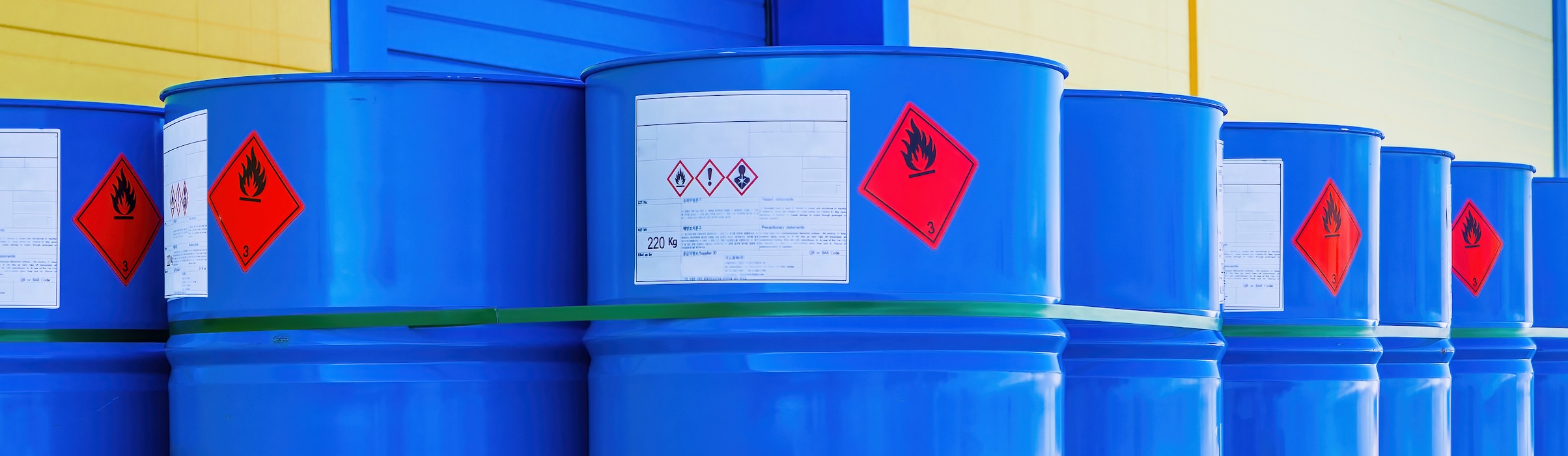
Hazardous waste is a special, legal subset of solid waste that businesses generate. There is not a single comprehensive list of hazardous waste that is continuously updated, as hazardous waste identification is a process that involves many steps. For a material to be a hazardous waste, the material must first be a solid waste. If you generate a solid waste, you are required to determine whether that material is a hazardous waste. This waste determination must be made the moment a material becomes a solid waste.
The U.S. Environmental Protection Agency (EPA) defines a solid waste as any discarded solid, semisolid, liquid or contained gaseous material that is diposed of, burned or incinerated, or recycled in certain ways. It can be the spent material or byproduct of a manufacturing process or a household item such as a cleaning fluid or battery acid. Recyclable materials or items that can be reclaimed or reused in some way (e.g., distillation of spent solvents, burning used oil for fuel) may also be considered solid waste.
Generally, waste is considered as hazardous by the federal government based on its characteristics. Waste is considered hazardous, if it is:
- Ignitable — Creates fire under certain conditions, spontaneously combustible, or has a flash point less than 140F (e.g., some paints, degreasers and solvents)
- Corrosive — Liquid capable of corroding metals or has a high or low pH (e.g., acids with a pH of less than 2, such as rust removers and battery acid, or alkaline fluids with a pH greater than 12.5, such as cleaning solutions)
- Reactive or unstable — Can cause explosions, toxic fumes, gases and vapors when mixed with water or under other conditions, such as heat or pressure (e.g., some cyanides and sulfide-bearing wastes)
- Toxic — Constituents listed under 40 CFR § 261.24 that are harmful or fatal when ingested or absorbed, or leaches toxic chemicals into the soil or ground water (e.g., wastes with high concentrations of heavy metals, such as cadmium, lead or mercury)
The EPA also has four lists describing hundreds of specific wastes and waste streams as hazardous (F, K, P, U). These are what is known as listed waste. These wastes can be industry specific, process specific, or commercial chemical products depending on the list.
In addition, a mixture of hazardous waste with solid waste (e.g., contaminated motor oil with trash or debris) or wastes derived from the treatment of hazardous waste (e.g., wastewater treatment sludge) may be considered hazardous waste.
To obtain or manage a U.S. Environmental Protection Agency (EPA) identification number (ID), hazardous waste generators, transporters, and permitted facilities must be registered on myDEQ | Learn More About myDEQ Reporting >
To determine requirements:
- First, look at each of your waste streams and determine whether the waste is hazardous.
- Measure how much hazardous waste your business produces each month. This will determine your business' generator category and the management requirements that must be followed.
To determine your generator category, you would measure all quantities of listed and characteristic hazardous waste that are:
- Generated and accumulated on site for any period of time before disposal or recycling. For example, dry cleaners must count any residue removed from machines, as well as spent cartridge filters.
- Packaged and transported away from your business.
- Placed directly in a regulated treatment or disposal unit at your place of business.
- Generated as still bottoms or sludges and removed from product storage tanks.
Many hazardous wastes are liquids and measured in gallons, not pounds. Liquid hazardous wastes must be converted. Water's specific gravity is 1, and 1 gallon of water weighs 8.34 pounds. So, if you have a 55 gallon drum with 50 gallons of water, the equation looks like this: ((1 x 8.34) x 50) = 417 pounds. We say 50 gallons because you must always remember to leave headspace in a drum. Never fill a container all the way to the top. Replace the 1 with the specific gravity of the chemical you are working with. For example: 98 percent sulfuric has a specific gravity of 1.84. (1.84 x 8.34) = 15.3456 pounds per gallon. Now multiply that by 50 for a 55 gallon drum. (15.3456 x 50) = 767 pounds for a 55 gallon drum.
EPA has established three generator categories, each of which is regulated differently:
- Very Small Quantity Generators (VSQGs) generate no more than 220 pounds (100 kg) of hazardous waste in any month and store no more than 2,200 pounds (1,000 kg) of hazardous waste at any given time. VSQGs are conditionally exempt from hazardous waste management regulations provided that certain basic requirements are met.
- Small Quantity Generators (SQGs) generate between 220 and 2,200 pounds (100 and 1,000 kg) of hazardous waste in any month and store no more than 13,228 pounds (6,000 kg) of hazardous waste at any given time. SQGs must comply with EPA and state requirements for managing hazardous waste.
- Large Quantity Generators (LQGs) generate more than 2,200 pounds (1,000 kg) of hazardous waste in any month. LQGs must comply with more extensive hazardous waste rules.
Some wastes are so dangerous that they are called acutely hazardous wastes. If a business generates or accumulates more than 2.2 pounds (1 kg) of acutely hazardous waste or 220 pounds (100 kg) of acutely hazardous residue, debris, or soil in a calendar month, all of the acutely hazardous waste must be managed according to the regulations applicable to LQGs.
A transporter is any person engaged in the offsite transportation of hazardous waste by air, rail, highway, or water. The EPA maintains records of transportation companies; therefore, transporters must obtain an EPA ID. Transporter EPA IDs are associated with the company’s headquarter address rather than a site location, as required for generators.
Hazardous waste manifests track shipments of hazardous waste from the generator to the ultimate destination. Hazardous waste shipments must be accompanied by a manifest; consult the regulations for alternative shipment documentation for transport by rail and water. Transporters must deliver the entire quantity of manifested waste to the next transporter or designated facility. Before transport, the transporter must sign and date the manifest to acknowledge receipt and return a copy to the generator before leaving the generator’s property. Transporters must retain a final copy of the manifest signed by the designated facility for three years from transporter’s acceptance.
If transporters discharge hazardous waste, they must take immediate and appropriate action to protect public health and the environment (e.g., notify authorities) and call the National Response Center for serious accidents or discharges. They must also clean up, or take authority-approved actions, to ensure discharge no longer threatens human health or environment. Transporters must also comply with all applicable Department of Transportation (DOT) requirements.
For additional information see Arizona Administrative Code (A.A.C.) R18-8-263 which incorporates by reference 40 § CFR 263 and EPA guidance | Learn More on EPA Website >
Generators of hazardous waste operating as Very Small Quantity, Small Quantity, or Large Quantity Generators do not need a permit for storing hazardous waste on site as long as they remain in compliance with the conditions for exemption for their category. Some on-site treatment may be allowed without a permit depending on the type of treatment or generator category.
Facilities performing the following activities require permitting regardless of generator category:
- Heat treatment
- Storage of hazardous waste for longer than 24 hours prior to recycling
- Corrective action sites
- Storage beyond generator time limits, i.e., 90 days for LQGs, 180 days for SQGs
- Storage beyond the universal waste time limit of one year
- Storage, treatment or disposal of hazardous waste accepted from off-site
- Land disposal
- Post-closure care
Activities that do not require permitting:
- 10-day storage areas
- Universal waste activities, e.g., disassembling batteries
- Elementary neutralization units
- Wastewater treatment units regulated under a Clean Water Act permit
- Generators accumulating hazardous waste on site and operating in compliance with all the conditions for exemption provided in 40 § CFR 262
For permitting regulations, including possible exclusions or exemptions, see Arizona Administrative Code (A.A.C.) R18-8-270, which incorporates by reference 40 § CFR 270.
A Resource Recovery and Conservation Act (RCRA) permit is a complex and stringent regulatory document. RCRA permits are issued for Treatment Storage, and/or Disposal Facilities (TSDF) (either operating, closing, or requiring post-closure care) and create enforceable requirements to protect public health and the environment from potential impacts from releases at the TSDF. New TSDFs are required to apply and receive a permit prior to constructing and operating a hazardous waste TSDF.
For permitting links, visit the "See More" sidebar.
Informal enforcement cases are expected to be corrected within 120 days, and are managed as either a Notice of an Opportunity to Correct (NOC) or a Notice of Violation (NOV). An NOC is issued if there are no alleged deficiencies that are a significant risk, unless the deficiencies are repetitive or intentional. An NOV is issued if there are alleged deficiencies that are a significant risk to any person, the public health, safety, or welfare, or the environment.
If compliance with informal enforcement will likely take longer than 120 days, cases may be escalated to formal enforcement. Formal enforcement typically includes a Consent Order or a Compliance Order negotiated under the direction of the Attorney General’s Office. Formal enforcement may also be pursued when it is necessary to abate an imminent and substantial endangerment to public health or the environment, such as cases requiring oversight and coordination of subsurface investigations and remediation of contaminated sites.